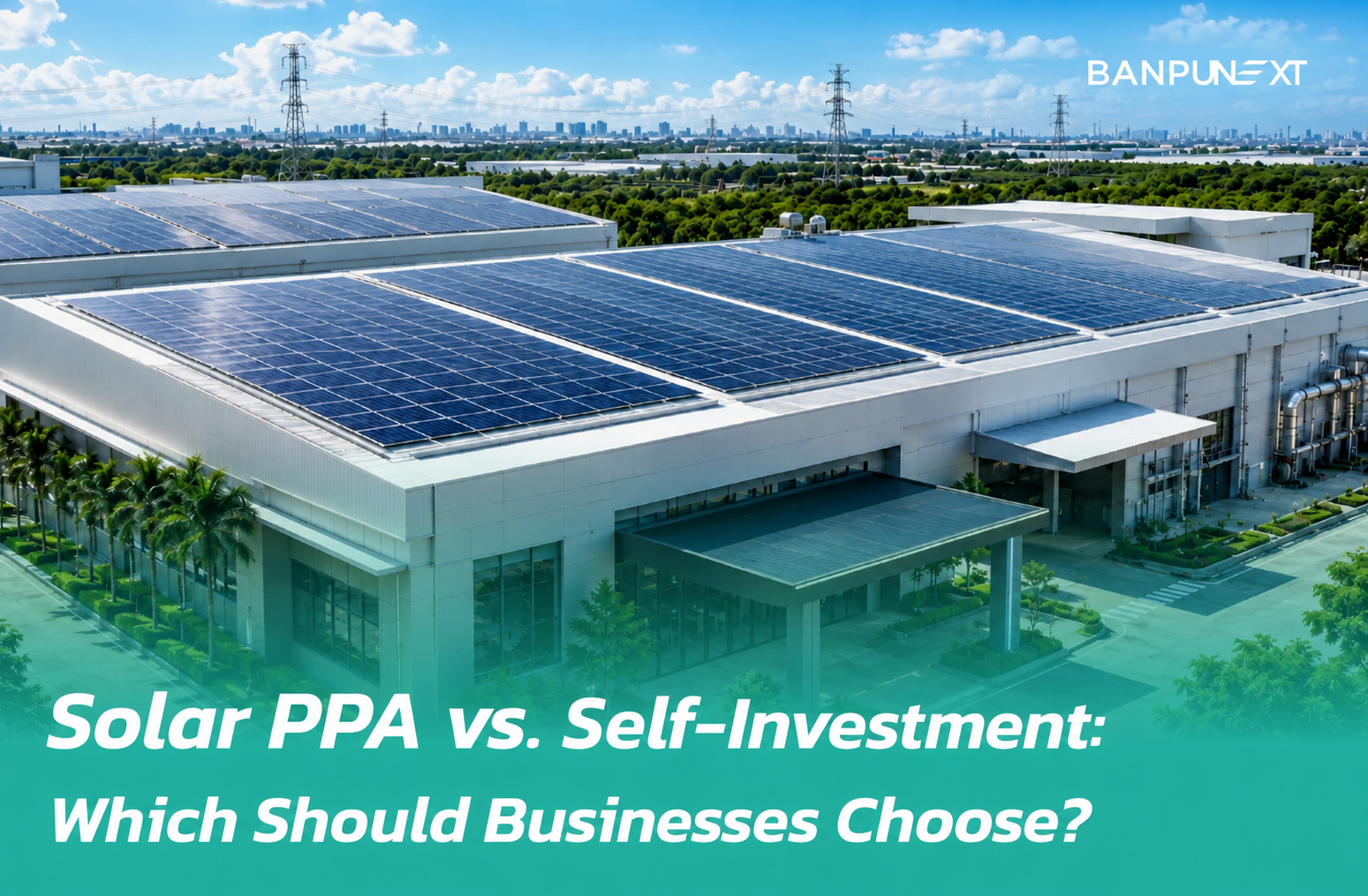
Amid the business challenges of 2026, the volatility of electricity costs—particularly higher Time-of-Use (TOU) rates during on-peak hours—combined with increasing pressure from global environmental regulations such as the Carbon Border Adjustment Mechanism (CBAM), are driving businesses to adopt clean energy solutions. Installing solar systems for factory has become a key strategy for reducing electricity costs while accelerating the journey toward Net Zero.
The key challenge for businesse is choosing the most cost-effective investment model. between the Solar Power Purchase Agreement (PPA) model, which requires zero upfront investment with the service provider financing the system and maintaining it throughout the contract period, and the Engineering, Procurement, and Construction (EPC) model, where business invest in and own the system 100%, support ed by end-to-end service provider at every stage. This article explores both options in depth, providing a comprehensive comparison to help you determine the best long-term solar investment model for your business.
Understanding the Two Main Solar Installation Models for Businesses
Commercial and industrial (C&I) solar installations generally fall into two primary models: Solar PPA, where the service provider finances the project, and Solar EPC (Direct Purchase), where the business invests in and owns the system. Each model differs in investment structure, asset ownership, financial returns, and operational responsibilities. Understanding these differences will help businesses select the solution that best aligns with their budget, financial management, and long-term growth objectives.
Solar PPA (Power Purchase Agreement): Install Solar with Zero Upfront Investment
A Solar PPA enables businesses to install solar systems on factories, warehouses, or commercial buildings without making a significant upfront capital investment. The service provider is responsible for financing, designing, installing, operating, and maintaining the entire system. In return, the business purchases the electricity generated by the solar system at a pre-agreed rate.
This model is ideal for businesses seeking to preserve cash flow while avoiding the capital expenditure and ongoing maintenance costs associated with solar ownership. Banpu NEXT’s Signature Package offers a zero-investment solar solution that allows businesses to transition to clean energy easily, backed by expert consultation and comprehensive project support throughout the contract period.
Solar EPC: Invest and Own Your Solar System from Day One
The EPC (Engineering, Procurement, and Construction) or Direct Purchase model allows businesses to invest directly in their solar system and become the full owner immediately after installation and payment. This enables companies to maximize electricity cost savings from the first day of system operation while adding a valuable energy asset to their balance sheet.
At Banpu NEXT, we go beyond being an EPC contractor. We provide comprehensive Net Zero Solutions and end-to-end solar energy system, covering every stage of the project—from energy consumption analysis and system design to installation, testing, commissioning, and post-installation maintenance. Our solutions also include real-time energy monitoring and system performance management to help businesses optimize energy efficiency.
Our Smart Package is designed for organizations that prefer to invest directly, own 100% of the system, and maximize long-term financial returns while supporting their Net Zero strategy.

Solar PPA vs. EPC: Cost-Effectiveness Comparison
The following comparison highlights the key differences between the two investment models, helping businesses identify the solution that best fits their financial and operational needs.
| Criteria | Solar PPA (Signature Package) | Self-Investment / EPC (Smart Package) |
| Upfront Investment | Zero upfront cost. The service provider covers the entire investment, including system installation and equipment. | The business invests 100% of the project cost based on the system size. |
| System Ownership | The service provider owns the system during the contract period. Ownership is transferred to the business upon contract completion. | The business owns the system immediately after installation and full payment. |
| Operation & Maintenance (O&M) | Free of charge throughout the contract period (typically 10–20 years). | Free of charge during the equipment warranty period or as specified in the service agreement. (After that, the business is responsible for maintenance or may purchase additional O&M services.) |
| Tax Incentives / BOI Benefits | Certain tax incentives may be retained by the service provider, depending on the contractual agreement. | The business may qualify for tax incentives, particularly when the solar system is installed together with an Energy Storage System (ESS) or battery storage. |
| Carbon Credits / I-REC Ownership | Ownership depends on the terms and conditions specified in the contract. | 100% owned by the business. |
| Payback Period | No payback period, as there is no upfront investment. Electricity cost savings begin from day one of operation. | Typically 3–5 years, depending on available tax incentives, system size, and electricity consumption patterns. |
Both Solar PPA and Solar EPC offer compelling advantages, depending on your business priorities. If your organization wants to adopt solar energy without capital investment while minimizing operational responsibilities, Solar PPA (Banpu NEXT’s Signature Package) is an ideal solution. On the other hand, if your business has available capital and seeks maximum long-term financial returns through full ownership of the solar asset, the Solar EPC model (Banpu NEXT’s Smart Package) provides greater long-term value.
Banpu NEXT is committed to being your trusted long-term partner for those interested in installing solar systems for factories and C&I businesses. We provide end-to-end Net Zero solutions, including energy management consulting, and organizational planning and execution toward Net Zero goals. Beyond helping businesses reduce electricity costs and improve energy efficiency, we also provide guidance on carbon reduction strategies, carbon credit management, and available tax incentives.
Three Key Factors Driving Solar Investment Decisions for Businesses in 2026
Before deciding between a Solar PPA and a Solar EPC (Direct Purchase) model, businesses should evaluate several strategic factors that influence capital allocation, financial performance, and long-term competitiveness.
1. Cash Flow and Financial Liquidity
If preserving cash flow for core business operations is a priority, a Solar PPA is often the most practical and financially secure option.
On the other hand, organizations with sufficient capital reserves that are seeking the highest long-term return on investment (ROI) may benefit more from owning the system through an EPC model. Once the payback period has been reached, all electricity savings belong entirely to the business. In addition, the solar system becomes a long-term energy asset that contributes to the company’s overall value.
2. Tax Incentives and BOI Benefits in 2026
Government incentives—including tax benefits and investment promotion programs from Thailand’s Board of Investment (BOI)—can significantly reduce project costs and shorten the payback period. These incentives are particularly attractive for businesses investing in solar systems together with Energy Storage Systems (ESS) or battery storage through the EPC model.
Owning the solar system after project completion also allows businesses to claim eligible tax incentives under applicable government regulations, increasing the overall financial value of the investment. Before making an investment decision, companies should review the latest incentive programs or consult an experienced energy solutions provider to identify the most suitable approach for their financial and tax planning strategies.
3. Ownership of Carbon Credits and I-REC Certificates
For businesses exporting to Europe or supplying customers subject to the Carbon Border Adjustment Mechanism (CBAM), ownership of Carbon Credits and International Renewable Energy Certificates (I-REC) has become increasingly important for creating confidence among investors and business partners.
In 2026, more organizations across multiple industries are accelerating their decarbonization strategies and Net Zero commitments, including:
- Manufacturing and industrial estates
- Food and beverage companies
- Logistics and transportation providers
- Retail businesses and shopping malls
- Hotels and tourism operators
- Office buildings
- Hospitals
- Educational institutions
- Data centers
- Real estate developers
These organizations are increasingly required to report their carbon footprint and demonstrate renewable energy usage to strengthen confidence among customers, investors, and other stakeholders.
Businesses that invest through the EPC model and own their solar systems have full control over Carbon Credits and I-REC certificates. For companies choosing a Solar PPA, ownership of these environmental attributes should be clearly specified in the contract to ensure alignment with the company’s sustainability objectives and long-term business strategy.
Which Solar Solution Model Is Right for Your Business?
Selecting the right solar investment model requires evaluating your organization’s investment capacity, expected return on investment, available tax incentives, and environmental reporting requirements.
Choose Solar PPA if your business:
- Wants to preserve cash flow.
- Prefers zero upfront investment.
- Wants to reduce electricity costs immediately.
- Prefers not to handle the operation and maintenance of the solar system itself.
Choose Solar EPC (Direct Purchase) if your business:
- Has sufficient investment capital.
- Wants full ownership of the solar system after project completion.
- Intends to maximize available tax incentives.
- Wants complete control over Carbon Credits and I-REC certificates.
- After the payback period, business benefit from generating its own electricity for free, enjoying long-term financial returns.
Accelerate Your Net Zero Journey with Banpu NEXT
If you’re looking for a solar solution for business that delivers measurable cost savings while supporting your Net Zero goals, Banpu NEXT is your trusted long-term Net Zero partner.
We provide comprehensive services covering every stage of your energy transition—from energy consulting and consumption analysis to system design, installation, commissioning, operation and maintenance, and long-term optimization. Whether you choose a Solar PPA or an EPC (Direct Purchase) solution, our experts help you select the package that best aligns with your business objectives and investment budget.
As a leading Net Zero Solutions Provider, Banpu NEXT offers a comprehensive portfolio of clean energy solutions, including:
- Net Zero consultation services
- Solar and Energy Storage Systems (ESS)
- Energy Management and Chiller Systems
- SolutionsCommercial EV Fleet Leasing and Fleet Optimization Platform
- Fleet Charging Solutions
These solutions are integrated with a digital platform that enables 24/7 monitoring through mobile applications and dashboards, allowing businesses to track system performance in real time. Supported by throughout the project lifecycle, Banpu NEXT helps organizations optimize energy efficiency, reduce long-term operating costs, and achieve sustainable business growth.
Contact us – Banpu NEXT
Calculate solar installation – Banpu NEXT
FAQ
Q1. How long is a typical Solar PPA contract, and what happens after it ends?
A: A Solar PPA contract typically lasts 10–20 years, depending on the project size and commercial agreement. At the end of the contract period, ownership of the entire solar system is generally transferred to the customer, allowing the business to continue using the system and enjoy long-term electricity savings.
Q2. Can businesses negotiate ownership of Carbon Credits or I-REC certificates under a Solar PPA?
A: Yes. Although the service provider typically owns these environmental attributes because they finance the project, businesses can negotiate contractual terms regarding the ownership, allocation, or transfer of Carbon Credits and I-REC certificates. This is particularly important for companies that need these certificates to support CBAM compliance or Carbon Footprint of Organization (CFO) reporting.
Q3. What does Banpu NEXT’s Solar PPA package offer?
A: Banpu NEXT’s Signature Package enables businesses to install solar with zero upfront investment, as Banpu NEXT finances 100% of the project. Customers benefit from immediate electricity cost savings through discounted solar power rates from the first day of system operation, guaranteed energy savings throughout the contract period, and comprehensive Operation & Maintenance (O&M) services at no additional cost. At the end of the 10–20-year contract term, ownership of the solar system is transferred to the customer.