In 2026, sustainability is no longer just a marketing trend—it has become a key driver of business growth. From gaining access to green financing and Green Loans to meeting increasingly stringent sustainability requirements from international partners and customers, businesses must now integrate environmental responsibility into their long-term strategies.
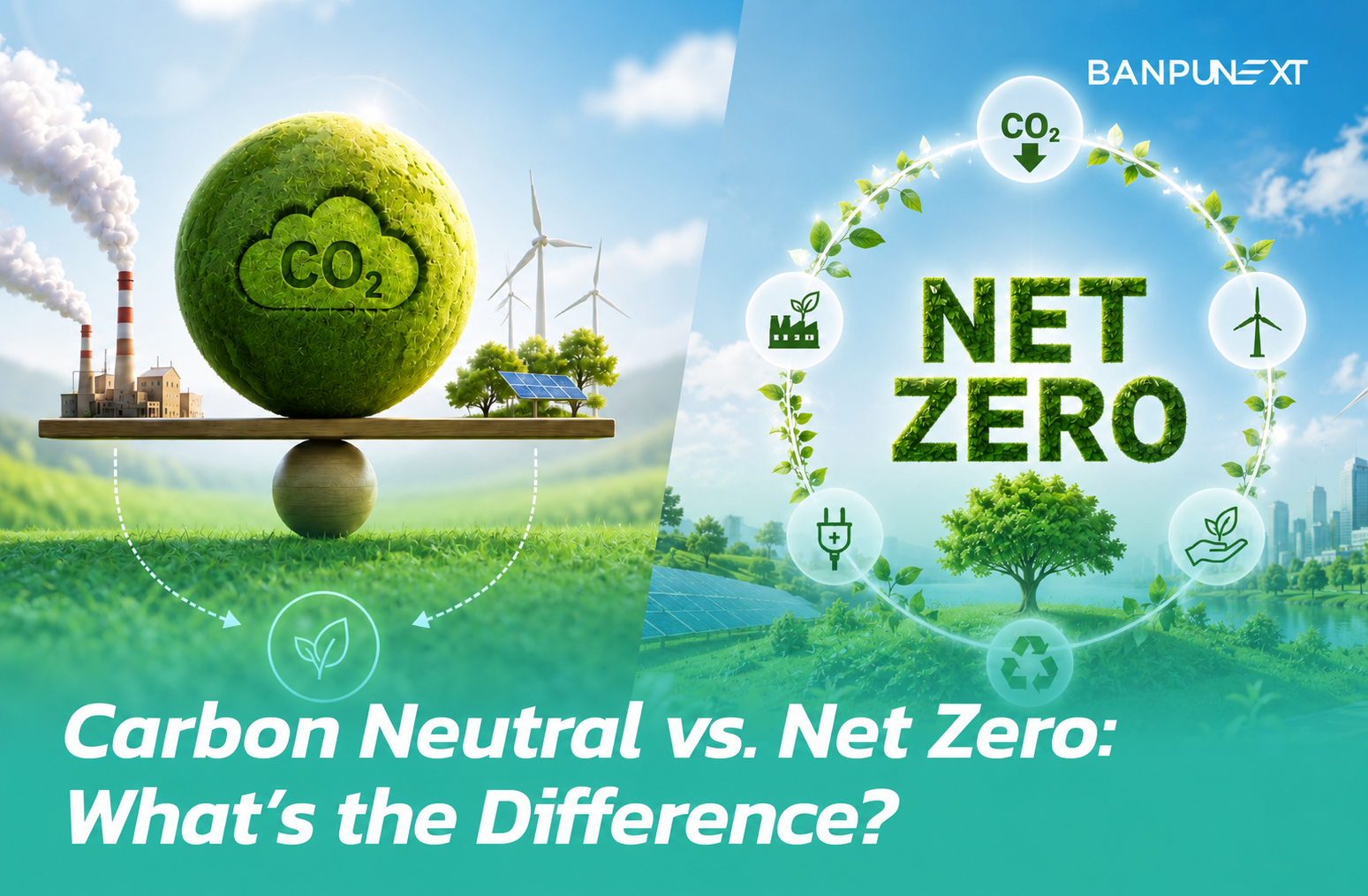
One of the most common questions organizations face is: What is the difference between Carbon Neutral and Net Zero? In terms of the Science Based Targets initiative (SBTi), they have distinct definitions, requirements, and implementation pathways under internationally recognized frameworks.
Understanding the difference between Carbon Neutrality and Net Zero is the first step toward building an effective climate strategy. The ultimate objective is to systematically reduce an organization’s carbon footprint and greenhouse gas emissions across Scope 1, Scope 2, and Scope 3. This article explores the key differences between the two concepts and provides practical guidance for businesses planning their sustainability journey. As a Long-term Net Zero Partner, Banpu NEXT supports organizations with end-to-end Net Zero solutions that help transform carbon management into sustainable business growth.
What Do Carbon Neutral and Net Zero Mean?
Carbon Neutral
Carbon Neutrality means that a business first reduces its carbon emissions as much as possible and then compensates for the remaining emissions through carbon offsetting, so that its net carbon emissions equal zero.
Common offsetting methods
- Purchasing carbon credits
- Reforestation and afforestation projects
The goal is to balance the amount of carbon emitted with an equivalent amount removed or offset.
Net Zero
Net Zero is a broader and more rigorous commitment. It covers all seven greenhouse gases, not just carbon dioxide (CO₂), but also gases such as methane (CH₄) and nitrous oxide (N₂O).
Under the SBTi Corporate Net-Zero Standard, organizations are expected to:
- Reduce greenhouse gas emissions across Scope 1, Scope 2, and Scope 3 by at least 90% from a defined base year.
- Neutralize only the small amount of unavoidable residual emissions through permanent carbon removals, rather than relying on conventional carbon offsets or avoidance credits.
In summary, both Carbon Neutrality and Net Zero share the common objective of mitigating climate change, but they differ in scope, ambition, and implementation.
Carbon Neutral focuses on balancing emissions through a combination of emissions reductions and carbon offsets, offering greater flexibility in the proportion and types of carbon credits used.
Net Zero, by contrast, requires organizations to prioritize substantial emissions reductions at the source across their entire value chain. Only residual emissions that cannot be eliminated may be addressed through permanent carbon removal solutions
Comparison Table: Carbon Neutral vs. Net Zero
| Comparison Criteria | Carbon Neutral | Net Zero |
| Greenhouse Gases Covered | Focuses primarily on carbon dioxide (CO₂) emissions. | Covers all seven greenhouse gases (GHGs). |
| Supply Chain Scope | Typically focuses on Scope 1 and Scope 2 emissions. | Covers Scope 1, Scope 2, and Scope 3 across the entire value chain. |
| Approach to Emissions Management | Businesses should reduce emissions where possible, but there is no mandatory reduction threshold. Remaining emissions can be offset using carbon credits. | Requires organizations to reduce emissions at the source by at least 90%, with only residual emissions addressed through permanent carbon removals. |
| Accepted Carbon Credits | May use avoidance credits and other eligible carbon offsets. | Only permanent carbon removal solutions are accepted for neutralizing residual emissions. |
| Level of Difficulty | Moderate; generally considered a short- to medium-term sustainability goal. | High; represents a long-term climate commitment. |
The comparison above shows that Carbon Neutrality offers businesses a more accessible starting point for managing carbon emissions through a combination of emissions reductions and carbon offsetting.
Net Zero, however, sets a much higher standard. It requires organizations to prioritize substantial emissions reductions across their entire value chain before addressing any remaining emissions through permanent carbon removal. As a result, Net Zero has become the long-term direction for businesses worldwide.
For this reason, many organizations begin by achieving Carbon Neutrality as an initial milestone before progressively advancing toward Net Zero as part of their long-term sustainability strategy.

Global Key Milestones on the Journey Toward Carbon Neutrality and Net Zero
International collaboration through landmark climate agreements has laid the foundation for Carbon Neutrality and Net Zero to become global standards and key business strategies today. Some of the most significant milestones include:
- Kyoto Protocol
The Kyoto Protocol was adopted during COP3 in Kyoto, Japan, in 1997. It was the first legally binding international agreement requiring developed countries to reduce greenhouse gas (GHG) emissions below their 1990 baseline levels. The protocol marked the world’s first concrete and legally enforceable framework for greenhouse gas emissions reduction.
- Paris Agreement
The Paris Agreement was adopted during COP21 in Paris, France, in 2015. Building upon the Kyoto Protocol, it expanded international climate cooperation to include both developed and developing countries.
Its primary objective is to limit the increase in global average temperature to well below 2°C above pre-industrial levels while pursuing efforts to limit warming to 1.5°C. Today, these targets serve as the cornerstone of global climate action.
- The 1.5°C Target
This refers to the maximum increase in global average temperature above pre-industrial levels that scientists consider necessary to avoid the most severe impacts of climate change.
According to the Intergovernmental Panel on Climate Change (IPCC), exceeding this threshold within the coming decades could result in widespread and irreversible consequences, including:
- More frequent and intense heatwaves
- Severe droughts
- Flooding
- Coral reef loss
- Rising sea levels
To keep global warming within 1.5°C, the world must reduce greenhouse gas emissions by approximately 50% by 2030 and achieve Net Zero emissions by 2050. These scientific targets have become the driving force behind the Net Zero commitments adopted by governments and businesses worldwide.
These global initiatives demonstrate that Carbon Neutrality and Net Zero are more than environmental concepts—they are essential mechanisms for restoring climate balance and ensuring a sustainable future.
For businesses, this means preparing for the transition by improving energy management and reducing carbon emissions throughout every stage of operations. Beyond mitigating climate impacts, these efforts also reduce operating costs and strengthen long-term competitiveness.
Understanding Scope 1, Scope 2, and Scope 3: The Building Blocks of Net Zero
Achieving Net Zero begins with understanding greenhouse gas emissions across all three emissions scopes. These scopes act like a helping businesses identify where emissions originate and determine the most effective reduction strategies.
Scope 1 – Direct Emissions
Scope 1 covers greenhouse gas emissions from sources that are owned or directly controlled by the business, including:
- Fuel combustion in factory equipment and machinery
- Emissions from company-owned vehicles
- Refrigerant leakage from air-conditioning or cooling systems
Scope 2 – Indirect Energy Emissions
Scope 2 refers to indirect emissions resulting from the purchase and consumption of energy, such as:
- Electricity purchased from the power grid
- Steam, heating, or cooling supplied by external utilities
Businesses can reduce Scope 2 emissions by adopting energy and improving energy efficiency
Scope 3 – Other Indirect Emissions
Scope 3 is often the most challenging aspect of a Net Zero strategy because it encompasses emissions across the entire value chain, including both upstream and downstream activities.
Examples include:
- Embedded emissions in purchased raw materials
- Transportation provided by third-party logistics companies
- Business travel and employee commuting
- Emissions generated during customer use of products
Scope 3 typically represents the largest share of an organization’s carbon footprint, yet it is also the most difficult to manage because it occurs outside the company’s direct operational boundaries.
For organizations pursuing Net Zero, understanding emissions across all three scopes is essential. Collecting accurate emissions data and developing comprehensive management strategies enables businesses to identify major emission sources and implement targeted, effective decarbonization initiatives.

Three Essential Steps for Businesses Beginning Their Carbon Reduction Journey
Achieving sustainability does not happen overnight. It requires a structured strategy that transforms greenhouse gas management into long-term business value. Businesses can begin with these three essential steps.
- Measure
Start by calculating your organization’s Carbon Footprint (CFO) to establish a reliable baseline across Scope 1, Scope 2, and Scope 3 emissions.
Accurate emissions data enables businesses to:
- Understand where emissions originate
- Identify the largest emission sources
- Prioritize reduction opportunities
- Set realistic climate targets
- Reduce
Focus on reducing emissions at their sources by:
- Transitioning to clean energy
- Improving energy efficiency in factories and commercial buildings
- Procuring International Renewable Energy Certificates (I-RECs) to reduce Scope 2 emissions
As a long-term Net Zero Partner, Banpu NEXT provides comprehensive decarbonization end-to-end solutions, including:
- Net Zero consult
- Solar and energy storage systems (battery storage)
- Energy Management Systems (EMS)
- EV fleet solutions
- EV charging for EV trucks and commercial fleets
These integrated solutions help businesses lower carbon emissions, reduce energy costs, and improve operational efficiency with measurable results.
- Offset or Remove
For residual emissions that cannot yet be eliminated, businesses should implement scientifically credible carbon removal strategies, such as:
- Supporting reforestation and ecosystem restoration projects
- Deploying Carbon Capture and Storage (CCS) technologies
Purchasing internationally recognized Removal Carbon Credits for achieving Net Zero under leading international standards.
Together, these three steps provide businesses with a practical roadmap for advancing their sustainability objectives while strengthening long-term competitiveness, reducing operational costs, and creating lasting business value.
Drive Your Carbon Neutral and Net Zero Goals with Banpu NEXT Solutions
Banpu NEXT provides comprehensive end-to-end Net Zero Solutions that help businesses accelerate their sustainability journey. It begins with Net Zero Consultation, offering expert advisory services, strategic roadmap development, greenhouse gas (GHG) assessment and carbon accounting, as well as implementations for reducing emissions across Scope 1, Scope 2, and Scope 3.
Banpu NEXT also supports organizations in developing structured decarbonization strategies to achieve their Net Zero goals while delivering measurable business value. In addition, the company offers a range of clean energy solutions designed to reduce carbon emissions, including:
Banpu NEXT delivers solar Energy Storage Systems (ESS), or Battery Storage, enabling businesses to generate and store clean electricity for use 24/7. This solution helps reduce dependence on grid electricity while significantly lowering Scope 2 emissions.
Banpu NEXT provides end-to-end EV Fleet Solutions for commercial transportation and logistics businesses. Services include:
- Commercial fleet leasing
- Fleet charging solutions
- AI route optimization platforms
These integrated solutions improve transportation efficiency while helping businesses reduce Scope 1 emissions from company-owned vehicles.
Banpu NEXT’s Energy Management System (EMS) helps businesses optimize energy consumption and improve operational efficiency through advanced technologies, including:
- AI-controlled chiller systems that optimize building cooling performance
IoT-enabled sensors for real-time energy monitoring and unnecessary energy usage reduction
These help lower both Scope 1 and Scope 2 emissions while reducing operating costs.
Banpu NEXT designs customized solutions tailored to each business needs, helping customers move closer to their Net Zero targets while creating long-term opportunities for sustainable growth. Contact Banpu NEXT to discuss your Net Zero roadmap and discover the most suitable carbon reduction solutions for your business.
Contact us – Banpu NEXT
Frequently Asked Questions (FAQ)
Q1. If a company purchases carbon credits to offset all of its emissions, can it claim to be “Net Zero”?
- A: No. Purchasing carbon credits alone does not qualify an organization as Net Zero.
Under internationally recognized standards such as the SBTi Corporate Net-Zero Standard, organizations must first reduce greenhouse gas emissions across Scope 1, Scope 2, and Scope 3 by at least 90%.
Only the remaining residual emissions—up to approximately 10%—may be neutralized using Carbon Removal Credits, which permanently remove carbon dioxide from the atmosphere.
Q2. What is Thailand’s Net Zero target year?
- A: Following discussions at COP30 in November 2025, countries around the world reinforced the urgency of climate action to keep global warming within 1.5°C.
Thailand subsequently strengthened its national climate commitments by:
- Targeting a 47% reduction in greenhouse gas emissions by 2035
- Bringing forward its Net Zero target from 2065 to 2050, accelerating the goal by 15 years
This significant policy shift demonstrates Thailand’s commitment to addressing climate change while signaling to Thai businesses that accelerating decarbonization is becoming increasingly important for future competitiveness.
Q3. Which sustainability goal should SMEs pursue first—Carbon Neutral or Net Zero?
A: For most small and medium-sized enterprises (SMEs), Carbon Neutrality is generally the recommended starting point.
Compared with Net Zero, Carbon Neutrality typically involves a more manageable emissions boundary and greater flexibility in implementation and investment.
Businesses should begin with practical, high-impact initiatives that deliver quick returns, such as installing solar photovoltaic (PV) systems. Solar energy reduces Scope 2 emissions by replacing grid electricity with renewable power while lowering electricity costs from the first day of operation.