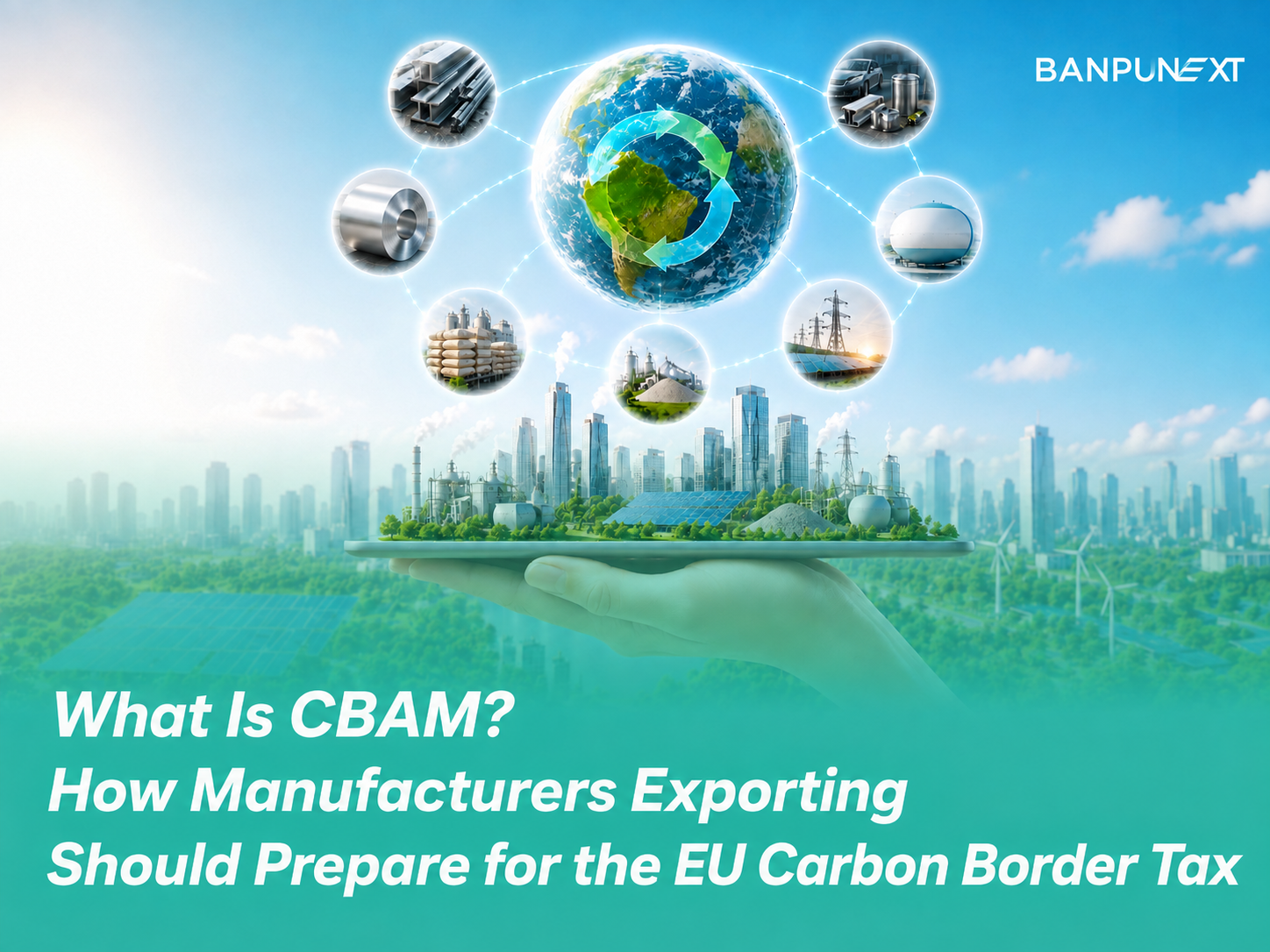
The Carbon Border Adjustment Mechanism (CBAM) is no longer a future concern—it is now a real business challenge. As of 1 January 2026, the European Union (EU) has officially entered the Definitive Phase of CBAM, making the regulation fully enforceable. This means that every tonne of embedded carbon emissions in imported goods will now carry a real financial cost, as importers must purchase CBAM Certificates to cover those emissions. As a result, the cost of exporting to the EU is likely to increase. Unless Thai manufacturers adapt quickly, they risk losing competitiveness and business opportunities in global market.
This article explains the key actions exporters should take in 2026 and explores how end-to-end clean energy solutions from Banpu NEXT , a trusted Long-term Net Zero Partner can help businesses reduce greenhouse gas emissions, transform the burden of EU carbon costs into a competitive advantage, and achieve their Net Zero goals.
What Is the Carbon Border Adjustment Mechanism (CBAM)?
The Carbon Border Adjustment Mechanism (CBAM) is the European Union’s carbon pricing mechanism for imported goods with high greenhouse gas (GHG) emissions. It measures the embedded emissions generated throughout the manufacturing process—from raw material production to the finished product leaving the factory—and converts those emissions into a carbon cost.
EU importers are required to purchase CBAM Certificates corresponding to the embedded emissions of imported products. In effect, these certificates function as an EU carbon charge that reflects the environmental impact of goods entering the European market.
As a result, Manufacturers exporting goods to EUof , who are directly hit by higher costs from the carbon such as iron, cement, aluminium, fertilisers, and hydrogen should actively reduce carbon emissions. Manufacturers targeting the EU market must therefore improve production efficiency and implement effective carbon management strategies to lower costs and maintain long-term competitiveness.
What Is the Purpose of CBAM? Why Has the EU Introduced It?
The primary objective of CBAM is to prevent Carbon Leakage—a situation where EU-based companies relocate their high-carbon production to non-EU countries with less stringent environmental laws or greenhouse gas (GHG) regulations in order to reduce costs, before exporting those products back into the European market. Such practices undermine the EU’s efforts to reduce greenhouse gas emissions and combat climate change.
Beyond addressing carbon leakage, CBAM is designed to encourage trading partners and industries worldwide to adopt environmentally friending manufacturing. By establishing a fair and consistent carbon pricing system, the EU aims to ensure that European manufacturers are not placed at a competitive disadvantage against producers operating under weaker environmental standards.
While Europe also works to make its production standards cleaner and more sustainable, actively driving the reduction of greenhouse gas emissions.
Global scale to achiev Carbon Neutrality in line with international climate agreements.
CBAM 2026 Update: The Definitive Phase Makes Carbon a Real Business Cost
Before 2026, CBAM operated under its Transitional Phase (2023–2025). During this period, exporters were only required to report the embedded emissions associated with their products, including energy consumption and greenhouse gas emissions throughout the production process. Although businesses had to submit emissions data according to EU requirements, no carbon payments were required. The purpose of this phase was to help companies establish reporting systems and prepare for future compliance.
From 2026 onward, CBAM has entered the Definitive Phase, marking the beginning of full implementation. Importers into the EU are now required to purchase CBAM Certificates to offset the embedded emissions of imported products and settle their obligations annually based on verified emissions data.
As a result, carbon has become a direct production cost. The higher the embedded emissions in a product, the greater the financial burden. This means Thai goods exports to the EU may become more expensive than competing products with lower carbon footprints.
For export-oriented manufacturers, CBAM has become a significant cost factor that directly affects competitiveness. Preparing for Net Zero is an essential business strategy for companies seeking long-term success in the European market.
Six Industries Most Affected by CBAM
During the initial implementation of CBAM, the European Union has focused on six carbon-intensive industries with a high risk of Carbon Leakage. These sectors will be the first to face the full impact of the regulation:
- Iron and Steel – One of the most energy-intensive industries, with significant greenhouse gas emissions throughout the manufacturing process.
- Aluminium – Produces substantial emissions during smelting and refining.
- Cement – Generates large amounts of carbon emissions through both energy consumption and chemical reactions during production.
- Fertilisers – Agricultural products with considerable embedded emissions resulting from their manufacturing processes.
- Hydrogen – Carbon emissions are assessed based on energy sources and the method used to produce hydrogen.
- Electricity – Electricity imported through cross-border power grids is also subject to CBAM requirements.
Beyond these six sectors, CBAM is expected to gradually expand to downstream products that incorporate carbon-intensive materials such as iron & steel or aluminium. These include industries such as automotive and auto parts, electrical appliances, furniture and construction materials, and metal packaging. Although these products may not initially fall within CBAM’s direct scope, the carbon costs embedded in their raw materials can be passed along the supply chain, ultimately increasing production costs.
As downstream supply chains become increasingly affected by CBAM, manufacturers of finished products will need to work closely with their suppliers to accurately measure and verify embedded emissions. Preparing today through effective carbon data management and emissions reduction across the value chain is no longer simply about regulatory compliance—it is a strategic investment that strengthens long-term competitiveness and enhances the attractiveness of Thai exports in the European market.
CBAM’s : Key Milestones that Exporters Should Know
Understanding the CBAM implementation timeline enables Thai exporters to develop effective compliance and export strategies. Each phase carries different reporting obligations and financial implications.
Transitional Phase (2023–2025)
The Transitional Phase served as a preparation period, allowing EU importers and overseas manufacturers to become familiar with the CBAM reporting framework.
During this stage, businesses were only required to submit quarterly reports detailing the embedded greenhouse gas emissions associated with their imported products. No financial payment or carbon charge was imposed. This period provided manufacturers with valuable time to establish emissions monitoring systems, collect accurate data, and develop internationally compliant measurement and verification processes.
Definitive Phase (Starting 1 January 2026)
CBAM entered its Definitive Phase, making the mechanism fully operational from a financial perspective.
Under this phase, Authorised CBAM Declarants (EU importers) must purchase and deliver CBAM Certificates equivalent to the verified embedded emissions of imported goods. Emissions are calculated using verified emissions data, or default values where verified data is unavailable.
For Thai manufacturers, providing accurate, independently verified emissions data has become essential. Reliable emissions reporting helps trading partners calculate lower CBAM obligations, making exported products more competitive in the EU market.
Each year, importers must deliver the required number of CBAM Certificates according to the EU’s compliance schedule. Products with higher embedded emissions will incur higher CBAM charges, directly increasing import costs and potentially affecting product pricing.
Consequently, manufacturers that reduce emissions through initiatives such as clean energy adoption, solar power installations, energy efficiency improvements, and cleaner production technologies will benefit from lower CBAM costs and stronger competitive positioning.
Understanding this timeline allows businesses to recognize that the transition toward low-carbon manufacturing is no longer optional. Companies that act early can transform carbon compliance from an additional cost into a strategic advantage, strengthening customers and partners confidence and improving long-term competitiveness in the EU market.
Comparison : Transitional Phase vs. Definitive Phase (2026 Onward)
| Category | Transitional Phase (2023–2025) | Definitive Phase (From 2026) |
| Financial Obligation | No financial cost. (Businesses only submit emissions reports.) | Financial obligation applies. EU importers must purchase and deliver CBAM Certificates based on verified embedded emissions or default values where verified data is unavailable. |
| Reporting Requirement | Quarterly emissions reports. | Annual CBAM Declaration. |
| Import Eligibility | Any Reporting Declarant (general importers responsible for quarterly carbon reporting). | Only Authorised CBAM Declarants (EU importers officially authorised under CBAM) are permitted to import covered goods. |
| Emissions Verification | Self-declared emissions data from manufacturers is accepted. | Emissions data must be verified by an Accredited Verifier. |
| Penalty for Missing or Unverified Data | Warnings or relatively low penalties. | The EU applies Default Values (typically conservative estimates) together with additional per-tonne carbon-related penalties (top-up penalties) where applicable. |
From 2026 onward, CBAM represents a real carbon cost rather than a reporting obligation alone. If a manufacturer cannot provide verified emissions data, the EU will apply country- and product-specific Default Values, together with a 10% mark-up in 2026.
Because these default values are based on national average emissions rather than the actual performance of an individual factory, even highly efficient manufacturers may end up paying significantly higher CBAM costs if they fail to provide verified emissions data.
For this reason, reducing carbon emissions throughout the manufacturing process while utilizing clean energy solutions— that lower both energy costs and Scope 2 emissions—combined with maintaining accurate, independently verified emissions data, is the most cost-effective strategy for managing CBAM compliance. This approach helps businesses minimize carbon costs, protect their competitiveness, and secure long-term access to the EU market.
Four Immediate Actions Thai Businesses Should Take to Protect Their EU Customer Base
With CBAM now fully in force, Thai exporters must take proactive steps to remain competitive and successfully navigate the EU’s carbon border requirements. Businesses should prioritize the following four actions:
1. Calculate Product-Level Carbon Footprints (Embedded Emissions) in Line with EU Standards
Begin collecting emissions data and clearly distinguish between:
- Scope 1 emissions – Direct emissions from fuel combustion and on-site manufacturing processes.
- Scope 2 emissions – Indirect emissions from purchased electricity.
These emissions must be calculated using the methodologies and formulas specified by the EU to accurately determine the embedded emissions of each product.
2. Verify The Carbon Footprint Data Obtain Independent Through Certified Third-Party Verification in the EU
To enhances transparency and provides importers with confidence that the reported emissions comply with CBAM requirements.
3. Accelerate Decarbonization
Reduce greenhouse gas emissions by transitioning to renewable energy, improving energy efficiency throughout production processes, and sourcing low-carbon or recycled raw materials wherever possible. These initiatives not only reduce emissions but also improve long-term operational efficiency.
4. Collaborate Closely with EU Importers
Exporters should work closely with their EU trading partners to ensure proper CBAM compliance. This includes supporting importers in fulfilling their obligations as Authorised CBAM Declarants, submitting accurate emissions information, and preventing customs delays or import disruptions.
Manufacturers that begin collecting verified carbon data, reducing emissions, and strengthening collaboration with EU customers today will gain a significant competitive advantage and improve their ability to retain long-term business in the European market.

Reduce Your Carbon Footprint and Energy Costs with Banpu NEXT
As CBAM turns carbon emissions into a tangible business cost, partnering with an expert Net Zero solutions provider can help manufacturers simultaneously reduce greenhouse gas emissions and lower energy expenses.
As an End-to-End Net Zero Partner, Banpu NEXT supports businesses throughout every stage of their decarbonization journey—from strategic planning to implementing integrated clean energy solutions tailored to manufacturing operations.
End-to-End Net Zero Solutions
Banpu NEXT provides comprehensive Net Zero services, including:
- Net Zero strategy development and roadmap design
- Greenhouse gas emissions assessment and carbon accounting
- Decarbonization planning and implementation
- Providing Clean energy solutions such as solar power systems, high-efficiency chiller systems, and EV fleet solutions
- Sustainability and Greenhouse Gas
- Emissions reporting preparation that supports CBAM compliance
For businesses preparing for CBAM, Banpu NEXT helps develop practical strategies to achieve Net Zero while strengthening long-term competitiveness.
Solar and Energy Storage System (ESS)
Installing Rooftop Solar with an Energy Storage System (ESS) enables businesses to utilize clean energy24/7.
Key benefits include:
- Lower electricity costs
- Reduced Scope 2 emissions
- Lower long-term carbon costs
- Reduced CBAM obligations through lower embedded emissions
Energy Management System (EMS)
Banpu NEXT also provides intelligent Energy Management Systems (EMS), including AI-controlled chiller systems that utilize environmentally friendly refrigerants.
These solutions help businesses:
- Optimize energy consumption
- Improve operational efficiency
- Reduce greenhouse gas emissions
- Lower overall operating costs
Working with an expert Net Zero partner makes the sustainability transition significantly easier. Banpu NEXT delivers consulting, design, and implementation, of end-to-end clean energy solutions that help businesses reduce both their Carbon Footprint and energy expenses while strengthening global competitiveness and supporting sustainable long-term growth.
Contact us – Banpu NEXT
Calculate solar installation – Banpu NEXT
Frequently Asked Questions (FAQ)
Q1. What happens if a Thai factory cannot provide verified emissions data in 2026?
A: The EU will apply country- and product-specific Default Values under the CBAM Regulation, together with a 10% mark-up in 2026 (increasing to 20% in 2027 and 30% from 2028 onward).[
Because these default values are based on national average emissions rather than the performance of an individual factory, even efficient manufacturers may face significantly higher carbon costs than competitors that provide verified emissions data.
To minimize CBAM costs, Thai manufacturers should collect accurate emissions data and have it verified by an accredited verification.
Q2. Can carbon credits purchased in Thailand be used to offset CBAM carbon costs?
A: Under the current CBAM framework, voluntary carbon credits purchased in Thailand cannot be directly used to reduce CBAM liabilities.
The EU only recognizes carbon prices actually paid in the country of origin through mandatory government mechanisms, such as:
- Carbon taxes
- Emissions Trading Systems (ETS)
CBAM is designed to align carbon costs with those paid by EU manufacturers under the EU ETS, rather than functioning as an offset mechanism.
The most effective way to reduce CBAM costs is therefore to reduce emissions at the source and provide verified emissions data. Improving energy efficiency and adopting clean, such as rooftop solar, directly lowers embedded emissions and aligns with CBAM assessment methodologies.
Q3. When must CBAM Certificates for 2026 imports be purchased and delivered?
A: Carbon costs begin accruing for goods imported into the EU from 1 January 2026.
However, the financial settlement occurs the following year:
- 1 February 2027 – Importers may begin purchasing CBAM Certificates.
- 30 September 2027 – Deadline for submitting the Annual CBAM Declaration and delivering certificates covering imports made during 2026.[
Q4. What happens if a business fails to comply with CBAM?
A: Importers that do not hold Authorised CBAM Declarant status will not be permitted to import goods covered by CBAM into the EU. Failure to deliver the required CBAM Certificates may also result in penalties under the CBAM Regulation.
For Thai exporters, however, the greatest risk is not the financial penalty itself—since the importer is legally responsible—but rather losing access to EU supply chains.
EU importers are likely to prioritize suppliers that provide verified emissions data and demonstrate lower carbon footprints. Manufacturers unable to provide verified data will be subject to higher Default Values, making their products more expensive and increasing the risk that EU customers switch to alternative suppliers.
Q5. Will CBAM be expanded to cover additional products in the future?
A: The EU plans to expand CBAM to include downstream products manufactured from iron steel and aluminium, including:
- Automotive components
- Construction materials
- Electrical appliances
This expansion is expected to take effect from 1 January 2028.
The EU is also considering extending CBAM to additional sectors, including chemicals and plastics, in future phases.
Q6. Can installing solar panels really reduce CBAM-related costs?
A: Yes. Installing solar power systems for factories and commercial facilities can significantly reduce Scope 2 emissions associated with purchased electricity.
By generating clean electricity on-site, businesses can:
- Reduce electricity expenses immediately
- Lower embedded carbon emissions
- Reduce their CBAM exposure over the long term
- Improve the carbon competitiveness of products exported to the EU