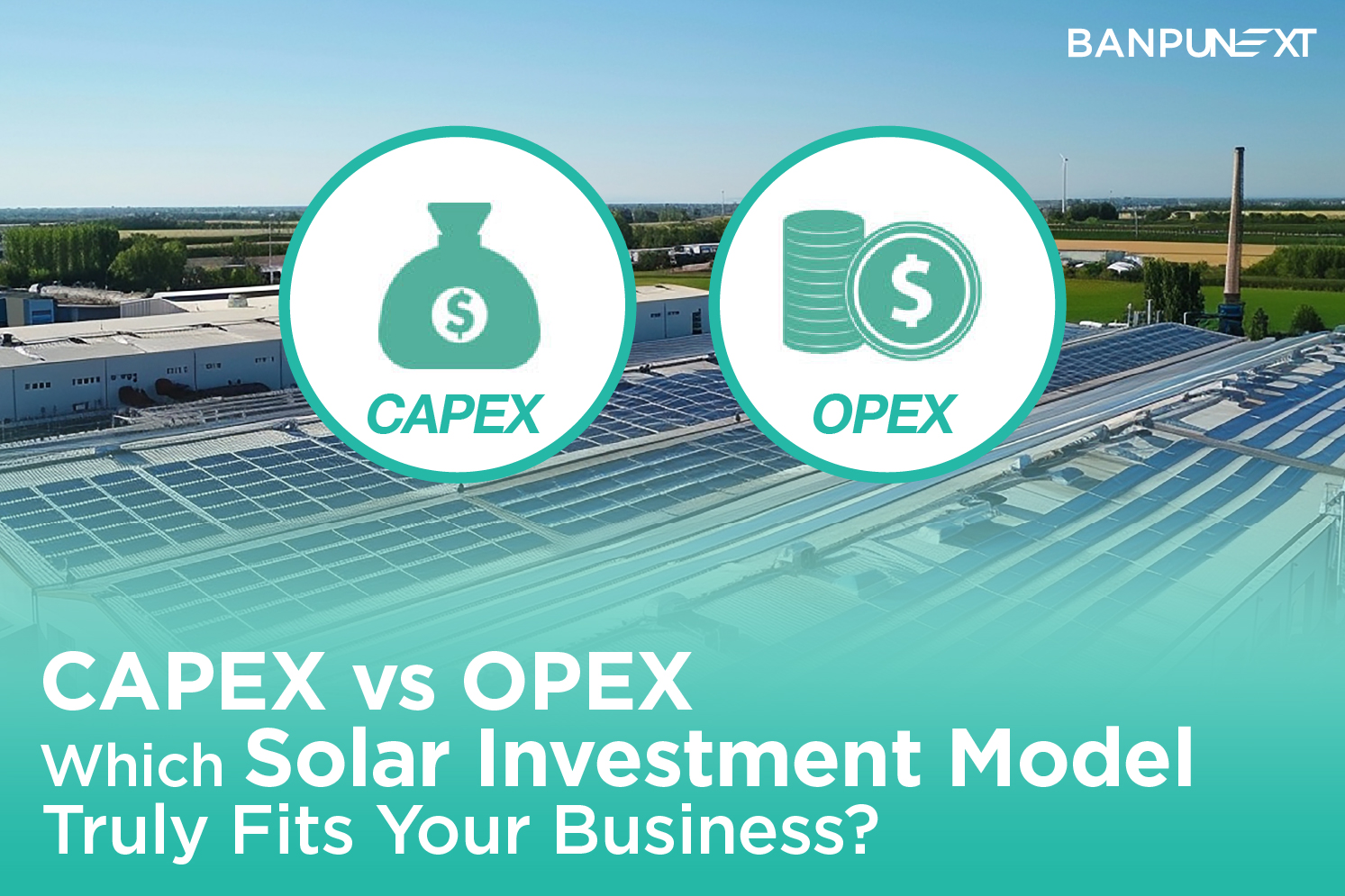
Solar power systems in the business sector are expanding rapidly, and many businesses are seeking solutions that are both cost-efficient and sustainable. The key question is: should you invest and own the system outright (CAPEX), or reduce costs with zero upfront investment through an OPEX model? These two approaches are not just “different payment methods”—they have a significant impact on cash flow, risk, and long-term returns for your business. Today, we’ll take a closer look at the essential differences between CAPEX and OPEX that you need to understand before deciding to go solar.
CAPEX: Investing and Owning the System Yourself
CAPEX, or Capital Expenditure, refers to the investment an organization makes to purchase, upgrade, or expand long-term assets. For solar power systems, CAPEX means paying the full upfront cost—covering everything from installation and solar panels to control systems.
Once installation is complete, the business owns the entire system and can use the electricity it generates for free throughout its lifespan (excluding maintenance costs). This model is ideal for businesses with available capital and seeking long-term returns.
Advantages of CAPEX
- Full system ownership with no usage or resale limitations
- No monthly electricity bills; enjoy free electricity throughout the system’s lifespan
- Eligible for tax benefits, including depreciation and tax deductions
- High long-term returns, especially for businesses with large electricity consumption
Considerations for CAPEX
- High upfront cost requiring a large one-time investment
- Responsibility for maintenance, as the owner must manage the system independently
- Technology risk, as future advancements may impact system performance
OPEX: No Upfront Investment — Pay Only for the Electricity You Use
OPEX, or Operating Expenditure, refers to ongoing operational costs in a business. For solar power, OPEX typically follows a PPA (Power Purchase Agreement) model, where the energy provider invests in, installs, and maintains the entire system.
The business simply buys the solar-generated electricity at a rate lower than the standard utility price, without any upfront investment. This model is ideal for businesses looking to adopt clean energy but limited by budget.
Advantages of OPEX
- No upfront investment, allowing immediate adoption of clean energy without affecting cash flow
- No maintenance responsibilities; the provider handles everything, including repairs, component replacements, and overall system upkeep
- Lower risk, with no concerns about system performance or unexpected maintenance costs
- financial flexibility, enabling businesses to allocate capital to other projects
Considerations for OPEX
- Businesses do not own the system, meaning it cannot be sold or transferred
- Long-term commitment, with contracts typically ranging from 15–25 years
- Total long-term cost may be higher, as the overall expense across the contract period can exceed self-investment
Why Banpu NEXT Is the Right Choice for Both CAPEX and OPEX?
Banpu NEXT is a leading Net Zero Solutions provider in the Asia-Pacific region, offering end-to-end solar installation services and tailored for businesses aiming to reduce energy costs and achieve their Net Zero goals.
- Comprehensive Solar Services – Banpu NEXT provides full-service support, from planning and installation to ongoing system management, helping your business lower electricity expenses and reduce CO₂ emissions.
- Advanced Digital Platform – Banpu NEXT’s solar systems come with a digital platform and mobile application that allow customers to monitor electricity production in real time, 24/7. Users can easily analyze system performance and track carbon footprint reductions from mobile devices anytime, anywhere.
- Complete After-Sales Support – Banpu NEXT offers 24/7 after-sales service. A team of experts continuously monitors system performance, resolves issues, and performs preventive maintenance to ensure maximum efficiency throughout the system’s lifespan.
- Totale Clean Energy Solutions – In addition to rooftop solar, Banpu NEXT offers floating solar, solar carports, energy storage systems (ESS), and microgrids to meet a wide range of clean energy needs across different industries.
Choose the Right Energy Model to Drive Your Business Forward
There is no single “right answer” when choosing between CAPEX and OPEX. The best option depends on several factors, such as your financial status, business objectives, and long-term strategy.
Banpu NEXT is ready to help you plan and design the most cost-effective and sustainable energy pathway for your business. With more than 40 years of energy expertise from the Banpu Group, Banpu NEXT builds on this foundation to deliver comprehensive smart energy solutions that are both efficient and sustainable—including solar rooftop, solar floating, or hybrid systems tailored to any industry.
This includes large industrial estates, factories, hospitals, hotels, shopping malls, gas stations, and educational institutions seeking to reduce electricity costs and transition to sustainable businesses.
Start Your Net Zero Journey Today
Contact us – Banpu NEXT
or calculate your solar installation cost
References
- Investopedia – CAPEX vs OPEX
- Solar Power World – Solar Financing Options
- Energy Sage – Solar Financing Guide
- AVAADA – CAPEX vs OPEX Solar